Shiba inu Transactions Require Network Compatibility Before Signing and On-Chain Verification Afterward
SHIB is an ERC-20 token deployed on Ethereum and can also be bridged to the separate Shibarium layer 2 network. Before a transfer, swap, or bridge, match the wallet network, token contract, receiving route, and gas asset. After signing, check the transaction status and destination balance on the same network.
Table of contents
The token standard and network identifiers are durable rules. Gas prices, exchange support, bridge availability, and confirmation requirements are live conditions, so review them at the point of action.
Bottom line: Match the SHIB contract, network, destination support, and gas token before signing, then confirm success on the corresponding block explorer.
Route Choice Before Commitment
The route depends first on where SHIB sits and where it must arrive. An Ethereum balance can move by ERC-20 transfer to an address or deposit service on Ethereum. A Shibarium balance travels within Shibarium. Moving value between those ledgers requires a supported bridge rather than a simple wallet network change.
A matching hexadecimal account address does not prove that the receiving service supports the selected network. A self-custody wallet may control the same address on both chains, while an exchange may accept deposits through only listed routes. Check its deposit network before signing because a confirmed transfer does not reroute itself.
Essential Terms for the Two Network Contexts
SHIB, Ethereum, and Shibarium describe related components, but each one answers a different compatibility question.
SHIB on Ethereum
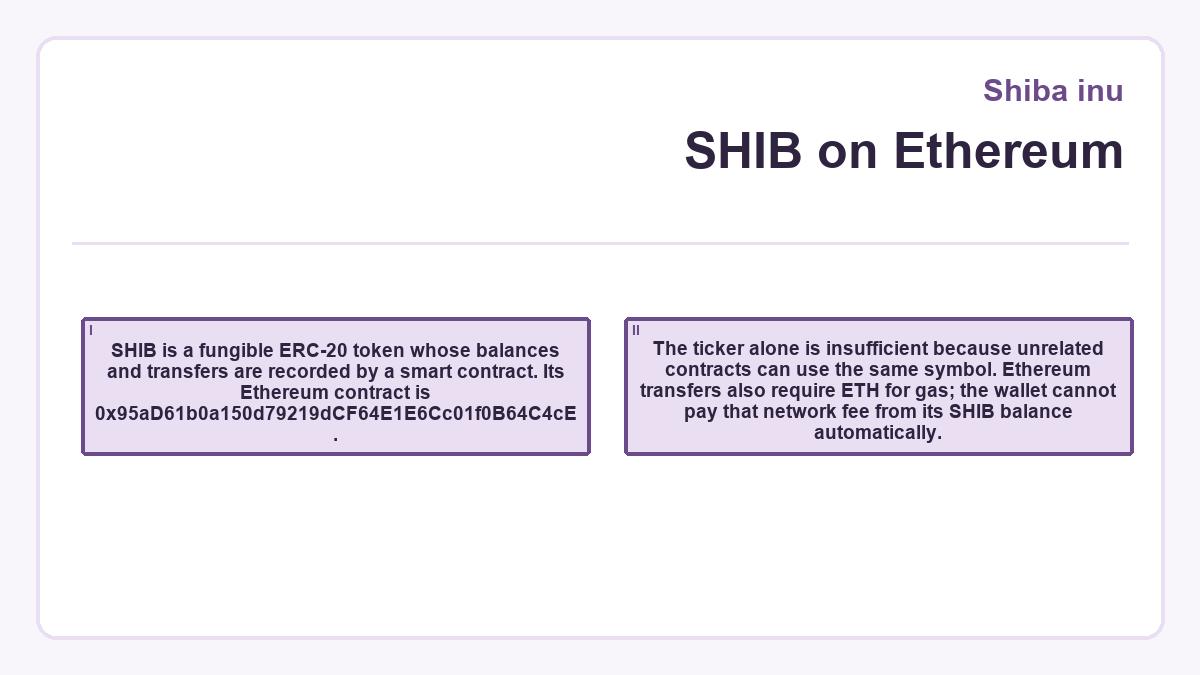
SHIB is a fungible ERC-20 token whose balances and transfers are recorded by a smart contract. Its Ethereum contract is 0x95aD61b0a150d79219dCF64E1E6Cc01f0B64C4cE. The ticker alone is insufficient because unrelated contracts can use the same symbol. Ethereum transfers also require ETH for gas; the wallet cannot pay that network fee from its SHIB balance automatically.
Shibarium as a Separate Network
Shibarium is an Ethereum-compatible layer 2 network with chain ID 109. It has its own transaction history, token contracts, balances, and block explorer. The same account can appear on Ethereum and Shibarium, yet each network records a separate state. Selecting Shibarium in a wallet only changes the ledger being viewed; it does not move existing Ethereum tokens.
Network-Specific Token Representations
Bridged SHIB uses a network-specific contract representation on Shibarium. Its relationship to locked Ethereum SHIB must come from the supported bridge mapping, not a shared name or logo. When adding a token manually, compare the contract address and network together. Correct decimals help a wallet display the balance, but they do not establish that a contract is authentic.
Wallet and Destination Compatibility
Wallet compatibility requires support for the selected EVM network, the relevant token contract, and transaction signing. A missing balance may mean the wallet is viewing the wrong chain or has not added the correct contract. It does not by itself show that the tokens were lost. Search the account address on the explorer for the network that actually processed the transfer.
Destination compatibility is narrower. A self-custody address may be usable on both networks when the same private key controls it, but a hosted account follows the provider's deposit policy. Use the network shown for that specific SHIB deposit. A general claim that a platform supports SHIB does not establish support for every network representation.
Costs Attached to Each Route
Transaction cost comes from the network and the chosen operation. Ethereum transactions consume ETH as gas. BONE is the native gas token on Shibarium. A bridge may require a source-chain transaction and a later completion step. A swap can also require a separate approval before the exchange transaction, with each submitted transaction carrying its own fee.
Gas estimates change with network conditions and the computation requested by a contract. An exchange can set its own withdrawal fee and minimum, which are separate from on-chain gas. Review the final fee, output amount, and network in the live interface. A low network fee does not offset an unsupported route or an incorrect token contract.
Preflight Checks and Retry Conditions
You can keep a Shibarium SHIB transfer reversible until the wallet submits the signed transaction. Use this short decision checklist before that commitment point:
- Confirm that the wallet shows Shibarium with chain ID 109.
- Match the displayed SHIB contract to the intended network representation.
- Confirm that the receiving address or service accepts Shibarium SHIB.
- Keep enough BONE available for the displayed network fee.
- Review the recipient, token amount, contract action, and total cost before approval.
If the preview shows Ethereum, an unknown token, or insufficient BONE, reject the request. No on-chain state has changed, so correct the mismatch and build a fresh transaction. After submission, the transaction hash identifies the attempt but does not prove success. Completion requires a successful status, the intended token transfer record, and the expected destination balance. If the transaction fails, identify the cause before creating another transaction.
How Do You Know the Transfer Really Finished?
A successful explorer record on the same network is the strongest evidence of on-chain execution. Check the status, block inclusion, sender, recipient, token contract, and transferred amount. For an ERC-20 transfer, the token transfer event should identify SHIB rather than only showing a successful call to an unfamiliar contract. A transaction hash without a success status identifies the attempted transaction but does not prove execution or delivery.
Wallet and exchange displays may update after the chain records the transaction. If the explorer shows success but the visible balance has not changed, confirm that the wallet is viewing the correct network and contract. A hosted service may wait for additional confirmations before crediting a deposit. Its pending label concerns internal crediting and does not rewrite the on-chain record.
Bridging Between Ethereum and Shibarium
A bridge changes the network representation of SHIB rather than transferring one ledger entry directly between chains. On an Ethereum-to-Shibarium deposit, the bridge locks tokens on Ethereum and creates a matching pegged amount on Shibarium. The reverse process burns the Shibarium representation and unlocks the corresponding Ethereum tokens. This accounting does not remove network fees or completion conditions.
Bridge support must cover the exact token and direction. The selected withdrawal method can also affect the required steps and completion time. Read the live transaction state before starting another attempt, especially when one chain has confirmed and the destination step remains pending. Sending tokens directly to a contract address copied from an earlier bridge transaction does not reproduce the bridge operation.
Approvals and Swap Conditions
Token swaps introduce permission and market conditions that do not apply to a plain transfer.
Approval Scope
An ERC-20 approval authorizes a spender contract to move tokens up to an allowance. It does not execute the swap itself. Check the spender, allowance, and network before signing. An exact allowance limits unused permission, though another approval may be needed for a later transaction. Revoking an allowance blocks future use under that permission but cannot reverse a completed transfer or swap.
Quote and Execution Limits
A swap quote can change before execution because pool balances and network conditions move. A quoted minimum received amount sets the boundary at which the swap should revert instead of accepting a worse output. A reverted swap may still consume gas because the network processed its computation. An earlier successful approval can remain active, so inspect both records before retrying the exchange transaction.
Supply, Burns, and Price Claims
SHIB supply figures need a defined scope. Total supply, circulating supply, locked bridge balances, and inaccessible burned balances describe different quantities. A bridge lock is not a burn because the locked amount supports a representation on another chain. Counting both the locked tokens and their pegged representation as separate economic supply would duplicate the same underlying amount.
A verified burn reduces accessible supply when tokens enter an address from which they cannot be spent or a contract permanently destroys them. The transaction proves the burn action, but it cannot establish a future market price. Market capitalization equals token price multiplied by circulating supply, so any price target also implies assumptions about supply, liquidity, and demand. Those assumptions should remain separate from verified on-chain events.
Custody and Recovery Boundaries
Custody determines who can authorize a transaction and who may be able to help when a route is unsupported.
Self-Custody Responsibility
A private key or recovery phrase controls signing authority for a self-custody account. Anyone who obtains it can move the account's assets, while losing it can make recovery impossible. A hardware wallet can reduce key exposure, but it cannot correct a malicious approval or wrong recipient that the owner confirms. Read the requested permission as well as the visible token amount.
Hosted Account Boundaries
An exchange or custodian controls the keys for its deposit addresses and sets the networks it will credit. Depositing through an unsupported network may leave tokens on an address that the service controls without creating an account balance. Recovery then depends on the operator's technical access and policy. A successful blockchain transaction does not compel a hosted service to support that asset representation.
Uses Beyond a Basic Transfer
SHIB can be held, transferred, swapped, bridged, or used with applications that explicitly support its contract and network. Payment acceptance also depends on the merchant or processor supporting the selected route. Shibarium applications may handle SHIB, but their transaction fees still use BONE. Other tokens in the wider ecosystem have separate contracts and roles, so shared branding does not make them interchangeable.
The suitable path changes when the destination changes. Ethereum-only support calls for Ethereum SHIB and ETH gas, while Shibarium support calls for the recognized Shibarium representation and BONE gas. When neither route is listed, stopping before submission preserves the ability to choose a compatible destination.
Details worth knowing about Shiba inu
Can a Shiba Inu Transaction Be Canceled After It Is Submitted?
Cancellation is possible only while the transaction remains pending and the network accepts a replacement with the same nonce before the original confirms. Some wallets present this as a cancel or speed-up action, but the replacement is another transaction and consumes gas. Once the original transaction is included and confirmed, it cannot be reversed. A bridge or exchange may also continue its own processing after the relevant on-chain transaction succeeds.
Why Can a Failed SHIB Transaction Still Consume Gas?
A failed transaction can consume gas because the network executed and recorded the attempted computation even though the requested state change reverted. The SHIB transfer or swap output should not complete when that call fails, but the native gas balance may decrease. Read the explorer status and available error data before retrying. A token approval from an earlier successful transaction may remain active even when the later contract call fails.
How Long Does a SHIB Transfer Take?
A SHIB transfer has no universal completion time because the route determines the process. A direct on-chain transfer depends on block inclusion and the receiver's confirmation threshold. An exchange may add internal review or crediting time after confirmation. A bridge has separate source and destination states, and some withdrawal methods require additional finalization. Track the submitted transaction and service status rather than treating a quoted estimate as a fixed deadline.
Are SHIB and BONE Interchangeable on Shibarium?
SHIB and BONE are separate tokens with different contracts and functions. SHIB is an ERC-20 token, while BONE pays gas for transactions on Shibarium and also has a governance role. Holding SHIB does not automatically provide the BONE required to submit a Shibarium transaction. A wallet can show both balances under one account, but sending, approving, or swapping one token does not authorize the same operation for the other.
When Might a SHIB Move Have No Public Transaction Hash?
A transfer recorded only inside a hosted platform may have no public transaction hash because the platform can update balances in its private ledger without sending an on-chain transaction. A withdrawal to an external wallet normally creates a blockchain record once it is broadcast. Before broadcast, a provider may show an internal request identifier instead. That identifier tracks the service's workflow but cannot be searched as an Ethereum or Shibarium transaction.
Which Recovery Options Exist After SHIB Is Sent on the Wrong Network?
Recovery depends on who controls the destination address on the network that received the tokens. If the same self-custody key controls that address, adding the correct network and token contract may reveal the balance. If an exchange controls the address but does not support that route, only its operator can attempt recovery, and it may decline. Tokens sent to an unrelated address generally cannot be retrieved without cooperation from that address's key holder.