Shiba inu Transfers Need a Receipt and Balance Check Before You Wait or Retry
Shiba inu transfer decisions start with the transaction hash, which identifies the submitted transaction rather than a completed transfer. Check that hash on the network used, read the receipt status, and confirm the expected token balance before deciding whether to wait, replace a pending transaction, retry a failed one, or stop.
On this page
Hash, Network, and Receipt as One Check
A reliable first check combines the exact transaction hash, the network where the wallet submitted it, and the resulting receipt. These parts answer different questions. The hash identifies one signed transaction, the network selects the ledger being examined, and the receipt shows whether that transaction entered a block and completed its execution.
The Transaction Hash
The transaction hash is a locator for one exact transaction. It is not a completion certificate. When an explorer recognizes the hash, compare the sending address, destination, nonce, token contract, amount, and decoded action with the intended transfer. A submitted or pending label means the transaction still lacks confirmed execution evidence.
The Selected Network
The selected network determines which transaction pool, receipt, and token balance matter. The same account address can appear on several compatible networks while holding separate balances on each one. Searching the wrong network can produce no result even when the transaction exists elsewhere, so match the explorer or wallet view to the network recorded at submission.
The Transaction Receipt
The receipt connects the hash to a block and reports execution status, gas usage, and event logs. A successful status shows that the transaction did not revert. For a direct SHIB transfer, the token event and recipient balance then show whether the intended movement occurred. Those checks prevent a successful approval or unrelated contract call from being mistaken for a completed transfer.
The Difference Between Pending, Missing, and Replaced
Pending, missing, and replaced transactions call for different responses. A pending transaction is known to a node or explorer but has no included receipt. A missing entry may reflect delayed propagation, a local submission problem, an endpoint difference, or a transaction dropped from a pool. A replacement uses the same sender nonce but has a different hash. Once one same-nonce transaction enters a block, the other cannot later become a separate transfer. A new transaction with a new nonce remains independent and could duplicate the payment.
When Should You Wait Rather Than Retry?
Waiting is appropriate when the correct hash remains pending, its decoded fields match the intended transfer, and the delay is acceptable. If urgency changes, a wallet replacement function can attempt the same transaction with the same nonce and a higher fee. An earlier pending nonce may need attention before later transactions can proceed. Do not create an ordinary new transfer simply because the first one is slow, since both transactions could eventually complete.
Successful Receipts and Token-Level Proof
A successful receipt settles the execution question, but the intended token result still needs inspection. Read the decoded action and logs rather than relying on the top-level destination alone. A contract-mediated transaction may call one contract while transferring tokens to another address during execution.
Receipt Status
Receipt status reports whether execution succeeded or reverted. A pending Ethereum transaction has no transaction receipt until it is included in a block. Once a receipt exists, its block reference and status provide stronger evidence than a wallet submission message. Status 0 indicates failure, while status 1 indicates execution without a revert.
The Transfer Event
The Transfer event connects the token contract with the sending address, receiving address, and token amount. Contract identity matters because a ticker alone does not identify a token. For a direct transfer, a successful receipt and the expected event establish the recorded token movement. A successful receipt without that event may describe an approval or another contract action instead.
The Recipient Balance
The recipient balance shows the current token state after execution. Read it on the same network and against the same contract used by the transaction. A wallet can lag, hide an unlisted token, or show a rounded value, while the contract balance has already changed. The on-chain balance and event record therefore take priority over a stale interface.
A hosted deposit adds an off-chain crediting step. Tokens may reach the service-controlled address before the service updates the customer account. Once the on-chain transfer is successful, sending SHIB again does not accelerate that internal process. Reconcile the deposit with the included hash, the selected network, and the service account instead.
Failed Execution and Mismatched Balances
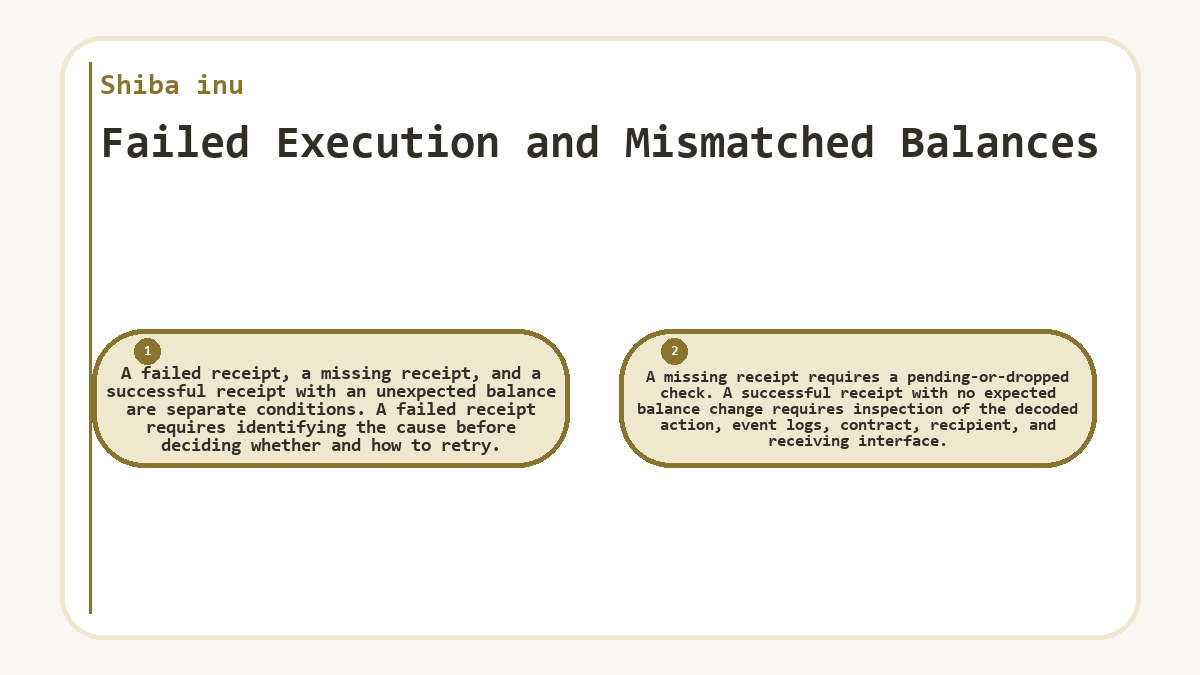
A failed receipt, a missing receipt, and a successful receipt with an unexpected balance are separate conditions. A failed receipt requires identifying the cause before deciding whether and how to retry. A missing receipt requires a pending-or-dropped check. A successful receipt with no expected balance change requires inspection of the decoded action, event logs, contract, recipient, and receiving interface.
Correcting a Failed Transaction
A failed transaction reverts its attempted token state changes, although the network can still charge for computation already performed. The cause may be an insufficient gas limit, inadequate token balance, missing allowance, or an unmet contract condition. Use any available error or revert information to isolate the cause. Correct that condition before retrying. A higher fee may improve inclusion, but it cannot repair a contract call that would revert again.
Reconciling an Unexpected Balance
A balance mismatch after status 1 starts with the action that actually executed. Confirm that the transaction called the intended token contract and produced the expected Transfer event for the intended address. If the event and on-chain balance are correct, the remaining issue lies in the wallet display or custodial credit. If the network, contract, or destination was wrong, another transfer does not recover the first one.
The Stop Point Before Another Signature
The final decision follows the strongest available evidence. Use this checklist before authorizing another transaction:
- Wait when the correct hash is pending and no replacement is necessary.
- Adjust a pending transaction through a supported replacement path, and retain both hashes.
- Retry after a failed or credibly dropped transaction only when the intended balance did not change.
- Reconcile with the receiving interface when execution and the Transfer event are correct.
- Stop when the expected Transfer event and balance change confirm completion. If a same-nonce replacement enters a block, stop waiting for the original hash and inspect the replacement result.
Before signing again, identify the unresolved condition that the new transaction would change. If it cannot change that condition, it creates a separate on-chain action rather than repairing the recorded one. The next decision is whether the remaining problem belongs to transaction execution, token state, or the receiving service.
Shiba inu: frequently asked questions
Can a Wallet Notification Replace an on-chain Receipt Check?
No. A wallet notification is an interface message and may reflect submission, local tracking, or a cached status. Match its hash to the correct network, then read the receipt and expected token movement. If the wallet and chain disagree, the chain record governs the transaction state. The distinction matters before any retry because the wallet can lag even when the transaction is already complete.
Why Can a Failed SHIB Transaction Still Charge a Network Fee?
A failed SHIB transaction can charge a network fee because validators performed computation before execution reverted. The revert removes the attempted token state changes, while the used gas remains chargeable; unused gas from the selected limit is not treated as consumed. A retry creates another fee-bearing transaction, so identify and correct the failure cause before sending the same instruction again.
Which Hash Should Be Saved After a speed-up Attempt?
Keep both the original and replacement hashes until one receives a receipt. A speed-up normally creates a new signed transaction with the same nonce and a different hash. Once one same-nonce transaction is included, the other cannot become a separate transfer. The included hash becomes the primary record, while the other explains why the earlier pending entry disappeared or was marked as replaced.
Does a Successful Approval Mean SHIB Reached the Recipient?
No. A successful approval changes the allowance that a specified spender can use; it does not by itself transfer SHIB to the intended recipient. The approval has its own receipt and Approval event. The approved spender must use that allowance in a later transaction before the approval can lead to a token transfer. That transaction's receipt, Transfer event, and resulting balance determine whether tokens moved.
Can re-adding SHIB to a Wallet Recover a Missing Transfer?
Re-adding SHIB can correct a display problem, but it cannot alter an on-chain transfer. Selecting the correct network and token contract may reveal a balance that already exists but was hidden by the interface. If the contract balance never changed, changing the displayed token list will not create the missing amount. Check the receipt and Transfer event before treating the issue as a wallet display fault.
When Should a Hosted SHIB Deposit Be Escalated to Support?
Escalate a hosted deposit after the on-chain receipt shows success, the expected Transfer event points to the assigned deposit address, and the service's stated confirmation or processing period has passed. Provide the transaction hash, network, deposit address, and amount so the service can reconcile its internal ledger. Never provide a seed phrase or private key; neither is needed to investigate a public transaction record.